
The Stack Method
A plain-English guide to stacking bank debt with seller-carried debt.
WHY STACK?
It's called a stack because the deal stacks bank debt directly with debt owed to the seller to optimize upfront liquidity, protection, and operational funding.
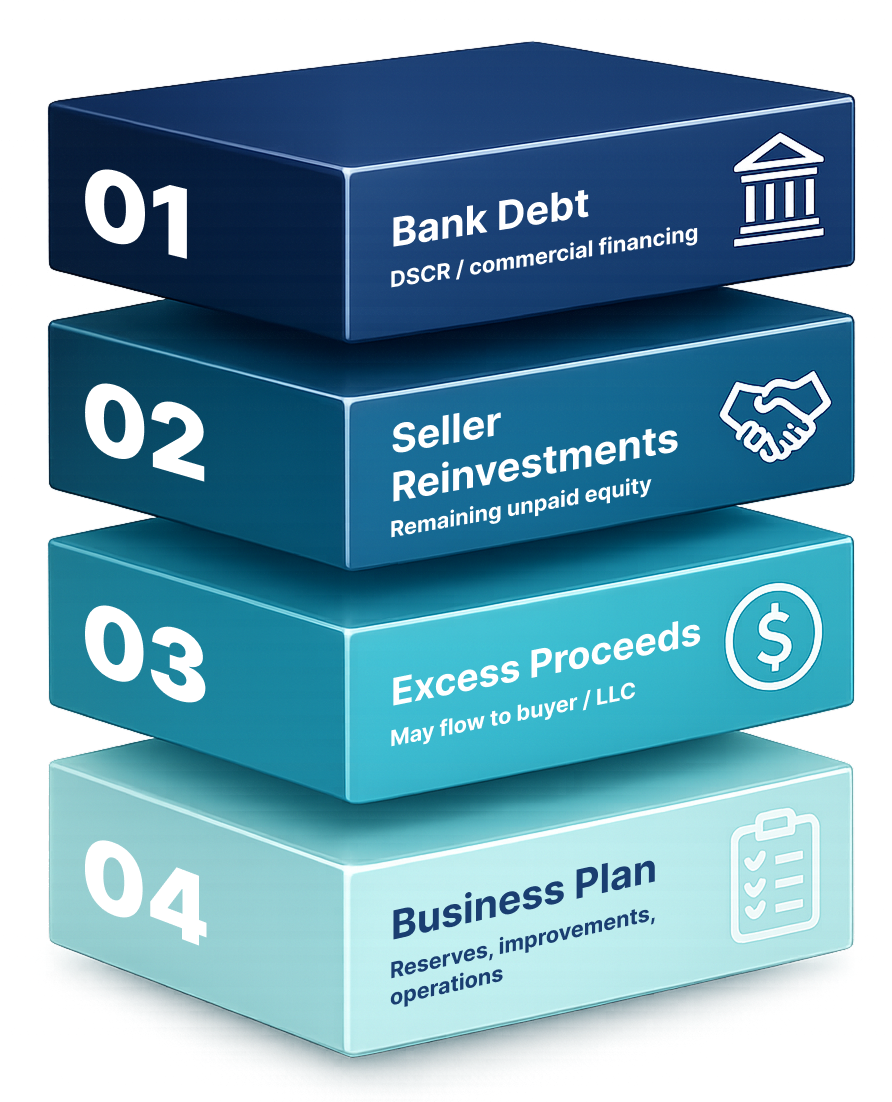
What Is a Stack?
A step-by-step definition of the structure, proving how stacking works from handshake to execution.
Contract price + seller terms
Buyer and seller agree to the purchase price, the seller down payment, and the remaining seller carried balance.
Outside financing
A DSCR or commercial loan is originated using the contract price, creating the larger upfront down payment to the seller at closing.
Seller receives the down payment
At closing, the seller receives the agreed upfront down payment from the proceeds generated by the financing structure.
Seller reinvestment into the LLC
The seller's remaining unpaid equity is carried into the purchasing LLC as preferred equity or seller carried business debt.
Excess proceeds may flow to buyer/LLC
After the seller down payment and transaction costs are covered, additional proceeds may reach the buyer or purchasing LLC for reserves, operations, or improvements.
Buyer executes business plan
The buyer operates the property, makes improvements if needed, and satisfies the seller's repayment terms over time.
Why Stack Method Is Changing Real Estate
- DSCR / Commercial financing creates the upfront seller liquidity.
- The seller's preferred equity protects remaining unpaid equity.
- Repayment flexibility can be structured uniquely to match deal parameters.
- Bank financing generates the down payment directly.
- Seller reinvestment preserves the security of remaining equity.
- Structure creates immediate improvement capital at closing.
Tampa, FL Deal & Dynamic Simulator
Study the exact metrics of HouseAble's Tampa Stack transaction, and plug in your own numbers to simulate any stack scenario instantly!
Deal Math Simulator
Tampa, FL Case Study
- Seller down payment:$100,000
- Closing & transaction costs:$31,000
- Buyer proceeds at closing:$79,000
Why the seller used preferred equity:
The seller did not receive a preferred return. The preferred equity position simply protected the seller's remaining unpaid equity and created recourse to reclaim control of the LLC in the event of default.
Who Does What?
Understanding the clear roles and separation of powers inside a Stack deal.
The Seller
- Sells the property cleanly
- Receives agreed upfront down payment
- Leaves remaining unpaid equity in purchasing LLC
- Holds preferred equity/seller carried position for protection
Buyer & Operator
- Acquires the overall asset
- Signs for property financing
- Receives excess proceeds at closing
- Executes improvements & business plan
Outside Lender
- Provides DSCR / commercial loan
- Holds 1st lien position on property
- Generates high-liquidity seller down payment
LLC Structure
- Acts as acquisition holding entity
- Holds seller's preferred equity position
- Recourse mechanism if buyer defaults
- Separates bank debt from LLC-level debt
Outside Lender
DSCR/Commercial financing originated.
Closing
The deal closes and seller receives down payment.
Seller Reinvestment
Remaining unpaid equity carried into the LLC.
Buyer Receives Capital
Excess proceeds flow for reserves & operations.
Buyer Executes
Buyer operates the asset and handles repayment terms.
Structure Advantages & Deep Dive
How Stack Deals optimize terms, preserve protection, and build robust capital structures from day one.
By pulling 1st position commercial bank debt (e.g., a DSCR loan at 60% LTV), we generate immediate liquidity. Since the seller is willing to carry the remainder as subordinate preferred equity, we can hand over a much higher cash component to the seller at closing than standard seller financing would traditionally allow.
The seller accepts preferred equity because it protects their remaining unpaid equity and creates recourse to reclaim control of the LLC in the event of default, while still allowing a clean sale and a larger upfront down payment than standard seller financing.
After the seller down payment and transaction costs are covered by the financing proceeds, any additional capital generated may reach the buyer or purchasing LLC for reserves, operations, or improvements.
Explore a Stack Deal for Your Property
Connect with HouseAble's expert financing team to see if your real estate acquisition fits the Stack Method profile.
Helping people find a path to homeownership when traditional lending isn't an option.
Copyright © 2026 All Rights Reserved | Powered by REICB